
Introduction
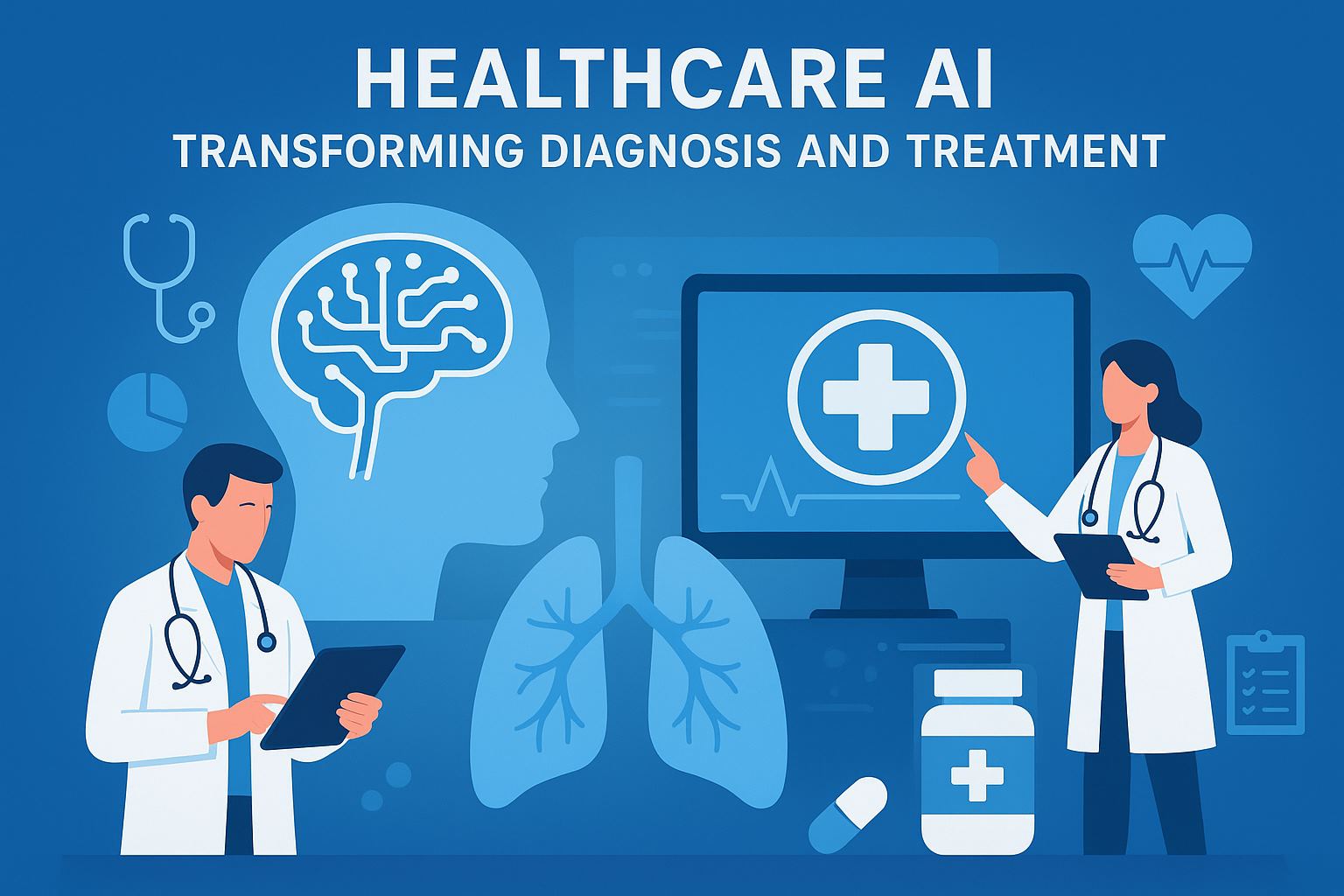
Healthcare AI is revolutionizing the medical field by enhancing diagnosis, treatment, and patient care. From faster and more accurate diagnosis to personalized treatment plans, AI-powered tools are helping doctors, hospitals, and patients achieve better outcomes. With the growing integration of machine learning, natural language processing, robotics, and predictive analytics, healthcare AI is no longer just a futuristic concept—it is a present-day reality.
In this article, we will explore how healthcare AI is transforming diagnosis and treatment, its benefits, challenges, real-world applications, and future potential.
The Rise of Healthcare AI
The global healthcare system has long faced challenges such as misdiagnosis, treatment delays, high costs, and physician shortages. Research shows that medical errors rank among the major causes of death worldwide. It offers a solution by analyzing massive amounts of medical data quickly and accurately, enabling healthcare providers to make evidence-based decisions.
The use of AI algorithms in radiology, pathology, genomics, drug discovery, and clinical decision-making has opened new opportunities to improve patient care while reducing costs. Technologies leveraging healthcare AI are driving innovation across these fields.
Healthcare AI in Diagnosis
One of the most impactful uses of healthcare AI is early and accurate diagnosis.
1. Medical Imaging and Radiology
AI-powered systems can analyze X-rays, CT scans, MRIs, and mammograms with a level of accuracy comparable to or sometimes exceeding human radiologists. These systems help in detecting diseases like cancer, pneumonia, fractures, and brain abnormalities. For instance, Google’s DeepMind developed an AI model that can detect over 50 eye diseases with high precision.
2. Pathology and Laboratory Analysis
AI tools are being used to analyze biopsy samples and identify abnormal cells that may indicate cancer or infectious diseases. Machine learning models can analyze thousands of samples in a much shorter time than it would take a human pathologist.
3. Genomic Analysis
AI plays a critical role in genomics, helping identify genetic disorders and predicting risks for certain diseases. This enables doctors to take preventive measures or offer personalized treatment.
4. Predictive Analytics
AI can process a patient’s medical history, lifestyle factors, and family background to predict potential health risks like diabetes, heart disease, or stroke. These insights allow for preventive care and lifestyle adjustments before major health issues develop.
Treatment
After diagnosis, AI also plays a major role in treatment and patient management.
1. Personalized Medicine
AI systems can analyze individual patient data—including genetics, age, and lifestyle—to recommend personalized treatment plans. This is especially effective in oncology, where every cancer case is unique. AI helps doctors decide on the right combination of surgery, chemotherapy, radiation, or immunotherapy.
2. Drug Discovery and Development
Developing new drugs is costly and time-consuming. AI speeds up the process by identifying promising compounds, predicting side effects, and even repurposing existing drugs for new conditions. AI technologies played a crucial role in speeding up vaccine development during the COVID-19 pandemic.
3. Robotics and Surgery
AI-powered robotic surgery systems assist surgeons in performing minimally invasive procedures with high precision. These robots reduce complications, shorten hospital stays, and improve patient recovery times.
4. Virtual Health Assistants
AI chatbots and virtual assistants help patients manage their health by answering medical queries, reminding them to take medications, and scheduling doctor appointments. This lightens the workload of healthcare professionals while giving patients more control over their own health.
5. Remote Patient Monitoring
With AI-enabled wearable devices, doctors can remotely monitor patient vitals such as heart rate, oxygen levels, and blood pressure. Real-time alerts can be sent in case of abnormalities, allowing for timely medical intervention.
Benefits of Healthcare AI
- Early Disease Detection – AI identifies diseases at an early stage, improving treatment success rates.
- Increased Accuracy – Reduces human error in diagnosis and treatment planning.
- Cost Efficiency – Minimizes unnecessary tests, hospital visits, and treatment costs.
- Customized Care – Delivers individualized treatment strategies based on each patient’s unique data.
- Faster Research – Speeds up drug development and clinical trials.
- Improved Accessibility – AI-powered telemedicine helps reach remote and underserved areas.
Challenges of Healthcare AI
Although highly beneficial, the use of healthcare AI also comes with certain challenges:
- Data Privacy and Security – Patient records are sensitive and must be protected.
- Bias in Algorithms – If training data is biased, AI systems may give inaccurate results.
- Regulatory Concerns – Approval and standardization of AI tools are still evolving.
- Integration Issues – Many healthcare providers struggle to integrate AI into existing systems.
- Job Displacement – Some fear that AI may replace certain healthcare roles, though most experts believe it will augment rather than replace professionals.
Future of Healthcare AI
Artificial Intelligence in Medicine
The future of healthcare AI looks promising. As deep learning, robotics, and cloud computing progress, AI is expected to:
- Predict outbreaks of infectious diseases.
- Enable real-time, continuous patient monitoring.
- Support precision medicine for chronic illnesses.
- Improve mental health diagnosis and therapy using AI-driven chatbots.
- Enhance surgical robots to perform complex procedures independently.
Healthcare AI will not replace doctors but will act as a powerful assistant, helping them make better decisions and provide superior patient care.
For more insights on how AI is transforming other sectors, explore our article on Top 10 AI Study Tools Every Student Needs in 2025–26 and Future of Technology & Software: Top Trends 2025-26.
Conclusion
The integration of healthcare AI is transforming how diseases are diagnosed, treated, and managed. By combining medical expertise with the computational power of AI, the healthcare
Additional Resources
For further reading on AI advancements, visit Guide on AI in healthcare.